


Real Estate development in Kenya is one of the most lucrative in the region as Kenya’s real estate sector is one of the fastest-growing in Sub-Saharan Africa. Urbanisation rates, a growing middle class, and sustained demand for residential, commercial, and mixed-use developments have positioned Kenya – particularly Nairobi, Mombasa, Kisumu, and the satellite towns surrounding the capital – as a compelling destination for both local and international real estate capital.
But real estate in Kenya is also a heavily regulated environment. Land tenure disputes, fraudulent title deeds, complex approval processes, and evolving planning legislation mean that developers and investors who move without strong legal grounding face significant exposure. This guide, published by Khayesi & Khayesi Advocates LLP (KNK Advocates), provides a structured legal framework for anyone looking to develop or invest in Kenyan real estate.
Kenya’s Land Tenure System: The Foundation of Every Transaction
Kenya operates a multi-tier land tenure system established by the Constitution of Kenya 2010 and operationalised through the Land Act, No. 6 of 2012 and the Land Registration Act, No. 3 of 2012.
The Three Categories of Land
Public land is held by the national or county government for public use. Community land is held by communities identified on the basis of ethnicity, culture, or similar interest. Private land is held by individuals or entities under freehold or leasehold tenure – this is the category most relevant to developers and investors.
Freehold vs. Leasehold
A freehold title grants the owner absolute ownership of the land in perpetuity. Leasehold titles – far more common in urban Kenya – grant possession for a defined term, typically 99 years for residential and 45 or 99 years for commercial. All leases granted out of public or government land require renewal at the end of the term, and the lessee must comply with the user covenants attached to the lease.
For foreign investors and developers, it is critical to understand that the Constitution of Kenya 2010, Article 65, restricts non-citizens to leasehold tenure for a maximum of 99 years. Foreigners cannot hold freehold land in Kenya.
The Regulatory Framework for Real Estate Development
Physical Planning and Zoning
Real estate development in Kenya operates within a planning framework governed by the Physical and Land Use Planning Act, No. 13 of 2019. Before commencing any development, a developer must obtain:
- A change of user permit if the intended use differs from the zoned use
- A development permission from the relevant County Government
- Construction permits from the county where the development is situated
- Environmental Impact Assessment (EIA) approval from the National Environment Management Authority (NEMA) under the Environmental Management and Coordination Act, Cap. 387
County governments exercise significant authority over development permissions. Processing times vary, and developers should factor regulatory timelines – often between three and twelve months – into their project schedules.
National Construction Authority Registration
All building contractors operating in Kenya must be registered with the National Construction Authority (NCA) under the National Construction Authority Act, No. 41 of 2011. Engaging an unregistered contractor exposes developers to regulatory liability and may invalidate insurance coverage on site.
Key Legal Processes in a Real Estate Transaction
Due Diligence on Title
Every real estate transaction in Kenya must begin with thorough due diligence on the title. This involves a search at the relevant land registry – either the Nairobi City County Land Registry, the relevant county registry, or the Lands Registry – to confirm:
- The registered owner of the property
- Whether the title is encumbered by a charge (mortgage), caution, or restriction
- The land reference number and area
- Whether the title is authentic and not subject to a pending dispute
KNK Advocates conducts comprehensive title searches and due diligence for clients acquiring land or property across all counties in Kenya. Learn more at our Conveyancing and Property Law practice page.
The Conveyancing Process
A property sale in Kenya follows a structured conveyancing process:
- Agreement for Sale – the parties execute a binding sale agreement setting out price, conditions, and completion timelines
- Completion documents – the seller provides the original title deed, land rent clearance certificate, land rates clearance certificate, and other prescribed documents
- Stamp duty assessment and payment – the buyer pays stamp duty to the Kenya Revenue Authority (KRA) based on the property value
- Transfer documents – the conveyancing advocate prepares and executes the transfer instrument
- Registration – the transfer is lodged at the relevant lands registry to update the register and issue a new title in the buyer’s name
Investment Vehicles for Real Estate in Kenya
Direct Property Ownership
The most straightforward investment vehicle is direct acquisition of land or developed property. This suits both individual investors and corporate entities seeking rental income or capital appreciation.
Real Estate Investment Trusts (REITs)
Kenya’s capital markets regulator, the Capital Markets Authority (CMA), established a REIT framework under the Capital Markets (Real Estate Investment Trusts) Regulations, 2013. REITs allow investors to access diversified real estate income streams through listed securities without directly holding property.
Special Purpose Vehicles (SPVs)
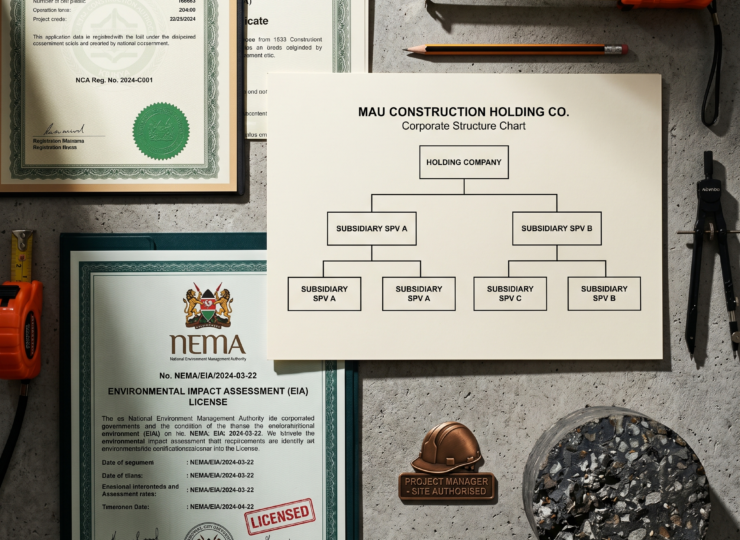
Large-scale development projects often use Special Purpose Vehicles – separate legal entities (companies or limited liability partnerships) created solely to hold and develop a specific property asset. SPVs limit liability, facilitate joint venture arrangements, and simplify project financing.
Joint Ventures
Joint ventures between landowners, developers, and capital partners are common in Kenya’s real estate market, particularly for large mixed-use projects. A well-structured joint venture agreement governs capital contributions, profit sharing, management rights, exit mechanisms, and dispute resolution. KNK Advocates regularly structures and advises on real estate joint ventures at our Commercial and Corporate Law practice.
Foreign Investment in Kenya’s Real Estate Sector
Kenya is open to foreign real estate investment, subject to the land ownership restrictions outlined above. Foreign investors may hold leasehold interests, invest through Kenyan-incorporated companies, or participate through REIT structures. The Kenya Investment Authority (KenInvest) provides investment certificates that facilitate land acquisition approvals for qualifying foreign investors.
Understanding tax implications is equally important: the Income Tax Act, Cap. 470 and the Value Added Tax Act, 2013 govern income from property, capital gains tax on disposal, and VAT on commercial property supplies.
Common Legal Pitfalls in Kenya’s Real Estate Market
Fraudulent titles: Kenya’s land registry has, in the past, been subject to cases of title fraud. Thorough title searches and physical verification of boundaries are essential.
Off-plan risks: Buyers in off-plan developments face exposure to developer insolvency, delayed delivery, and specification changes. A well-drafted sale agreement with escrow arrangements and performance guarantees mitigates this risk.
Encroachments and boundary disputes: Physical surveys to confirm actual boundaries against registered dimensions are a critical pre-acquisition step.
Incomplete approval chains: Developers who commence construction without full planning approvals face stop-work orders, demolition orders, and penalties from county authorities.
Defective lease extensions: Leases approaching their expiry require careful renewal management. A failure to renew on time can result in the land reverting to the state.
How KNK Advocates Supports Real Estate Developers and Investors
KNK Advocates brings more than 25 years of combined experience to every real estate mandate. Our Conveyancing and Property Law practice provides end-to-end support, including title due diligence, conveyancing, development structuring, JV agreement drafting, planning dispute resolution, and lease management.
Whether you are a local developer scaling your portfolio, an international investor entering the Kenyan market for the first time, or a diaspora Kenyan building your asset base back home, the legal architecture of your transaction determines whether your investment thrives or unravels.
Real estate development and investment in Kenya is governed primarily by the Land Act 2012, the Land Registration Act 2012, and the Physical and Land Use Planning Act 2019. Foreign and local developers must understand land tenure systems, permitting requirements, ownership restrictions, and conveyancing procedures before committing capital. KNK Advocates provides full-spectrum legal support for property transactions and development projects across Kenya.
Frequently Asked Questions: Real Estate Development and Investment in Kenya
Can foreigners own land in Kenya? Foreigners cannot hold freehold land in Kenya. Under Article 65 of the Constitution of Kenya 2010, non-citizens may only hold land on leasehold terms for a maximum of 99 years. Foreign investors may also access real estate through Kenyan-incorporated companies, though additional restrictions apply to companies with majority non-citizen ownership. KNK Advocates advises foreign investors on the optimal ownership structure for their investment objectives.
What is the stamp duty rate on property in Kenya? Stamp duty on property transactions in Kenya is payable to the Kenya Revenue Authority. For urban areas, the rate is 4% of the property value. For rural areas, the rate is 2%. The assessed value is determined by a government valuer appointed by the Chief Government Valuer. Stamp duty must be paid before the transfer instrument can be registered. See our detailed guide on stamp duty for a full breakdown of costs.
How long does property registration take in Kenya? Registration timelines at Kenya’s land registries vary. The Nairobi lands registry typically processes registrations in four to eight weeks under normal conditions, though backlogs can extend this timeline. Digital reforms through the National Land Information Management System (NLIMS) are progressively reducing processing times. KNK Advocates manages the full registration process on behalf of clients.
What due diligence should I conduct before buying property in Kenya? Essential due diligence includes an official registry search to confirm ownership and encumbrances, a physical survey to verify boundaries, a rates and land rent clearance check, an environmental search where applicable, a planning search to confirm approved user, and a litigation search to identify any court orders affecting the property. KNK Advocates conducts comprehensive due diligence packages for all property acquisitions.
What is a joint venture in real estate development in Kenya? A real estate joint venture is a contractual arrangement where two or more parties – typically a landowner, a developer, and a capital partner – pool resources to develop and sell or lease a property. The joint venture agreement defines each party’s contribution, management responsibilities, profit-sharing ratios, and exit rights. KNK Advocates structures and drafts joint venture agreements for development projects of all sizes.
Is off-plan property investment legal and safe in Kenya? Off-plan property purchases – where you buy before construction is complete – are legally valid in Kenya and governed by the sale agreement between the buyer and developer. The legal safety of your investment depends entirely on the quality of the sale agreement, the developer’s financial standing, the existence of escrow arrangements, and the clarity of delivery timelines and specifications. KNK Advocates reviews and negotiates off-plan sale agreements to protect buyers.
What taxes apply to real estate investment in Kenya? Real estate investors in Kenya face several taxes: stamp duty (on acquisition), land rent and land rates (annual obligations), income tax on rental income, withholding tax on rental payments by corporates, value added tax on commercial property leases, and capital gains tax of 15% on the net gain on disposal of property. KNK Advocates works alongside tax advisors to ensure clients are fully compliant.
How do I resolve a land dispute in Kenya? Land disputes in Kenya are handled by the Environment and Land Court established under Article 162(2) of the Constitution. Alternative dispute resolution mechanisms – including mediation under the Mediation Act 2012 and alternative dispute resolution clauses in sale agreements – are increasingly used to resolve disputes more cost-effectively. KNK Advocates handles land and property disputes through our General Litigation practice.
⚠️ Legal Disclaimer
The content of this article is published by Khayesi & Khayesi Advocates LLP for general informational and educational purposes only. It does not constitute legal advice and must not be relied upon as such.
Reading this article does not create an advocate-client relationship between you and Khayesi & Khayesi Advocates LLP or any of its advocates. The information provided reflects Kenyan law as at the date of publication and may not account for subsequent legislative changes, court decisions, or the specific facts of your situation.
Legal advice is fact-specific. A position that applies generally may not apply to your circumstances. To receive formal legal advice on your matter, you must formally engage Khayesi & Khayesi Advocates LLP by entering into a signed Letter of Engagement, at which point an advocate-client relationship will be established and privileged legal advice can be provided.
To begin the engagement process, contact us at [email protected], call +254 711 472 518, or book a free consultation.
Need Expert Legal Advice in Kenya?
Khayesi & Khayesi Advocates LLP (KNK Advocates) is a full-service law firm based in Nairobi, Kenya, with more than 25 years of combined experience in conveyancing, property law, and real estate development structuring.
We Know The Law, We Love The Law.
Whether you are a developer, investor, or landowner navigating Kenya’s real estate landscape, our team is here to move you forward.
📞 +254 711 472 518 📧 [email protected] 🌐 knkadvocates.co.ke 📅 Book a Free Consultation
Follow us: @knklegal | @knk_legal