

Published: July 2026 | Last reviewed: July 2026
Author: Victor Mulindi, Advocate of the High Court of Kenya
Practice Area: Commercial & Corporate Law
Article Type: Explainer (Comparative)
Content Classification: Evergreen
Estimated Read Time: 10 min read
Table of Contents
- The Threshold Point: Two Different Statutes
- Route One: Striking Off Under the Companies Act, 2015
- What Striking Off Is
- When Striking Off Is Available
- The Striking Off Process
- The Limits of Striking Off
- Route Two: Voluntary Liquidation Under the Insolvency Act, 2015
- What Voluntary Liquidation Is
- The Solvency Test: Which Type of Voluntary Liquidation Applies
- Concluding a Members’ Voluntary Liquidation
- Striking Off vs Voluntary Liquidation: The Comparison
- The Decision Test: Which One Applies to Your Company
- A Practical Kenyan Scenario
- How KNK Advocates Approaches Company Closure
- Conclusion
- Frequently Asked Questions (FAQs)
- Sources and References
- Legal Disclaimer
Striking Off vs Voluntary Liquidation in Kenya: Which One Applies to Your Company?
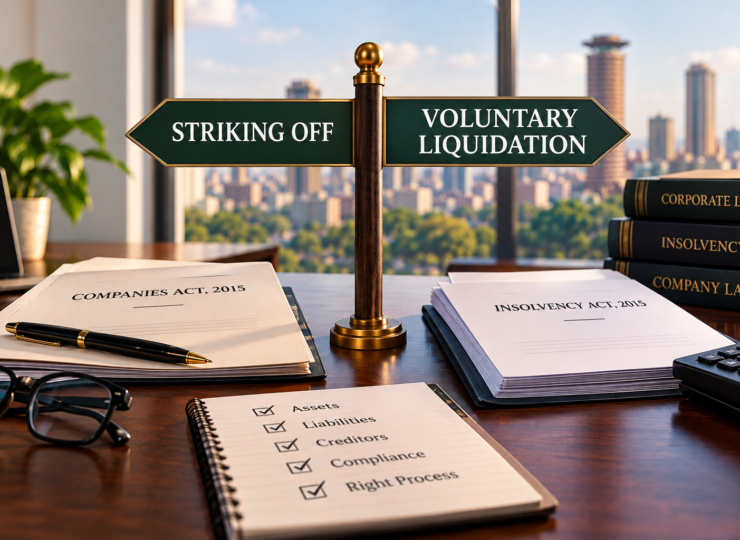
Striking off vs voluntary liquidation in Kenya is an important distinction for company directors and shareholders considering closing a business. Although both processes ultimately lead to the dissolution of a company, they differ in their legal requirements, eligibility, costs and treatment of outstanding debts and assets.
Choosing the wrong closure process can expose a company and its directors to creditor claims, restoration proceedings and other legal consequences. Understanding the applicable provisions of the Companies Act, 2015 and the Insolvency Act, 2015 is therefore essential before taking steps to close a company.
In January 2022, the Registrar of Companies struck Dream Dressing and Household Items Trading Company Limited off the Register. The directors had applied for voluntary striking off, the Gazette notice ran its course, and the company was dissolved. On paper, the business was closed.
Three years later, the High Court brought it back. In Kenya Revenue Authority v Dream Dressing and Household Items Trading Co. Limited & 3 others (Miscellaneous Application E005 of 2024) [2025] KEHC 3942 (KLR) (Commercial and Tax) (28 March 2025), Justice Namisi ordered the Registrar to restore the company to the Register. The reason was simple. The company had owed the Kenya Revenue Authority approximately KES 125,809,768.43 in unpaid tax at the point it applied to be struck off, and it had never served the Kenya Revenue Authority with a copy of that application, as section 900 of the Companies Act, 2015 requires.
The lesson for every Kenyan director is this. Choosing the wrong exit route does not close a company. It postpones the problem, adds three years of accruing penalties and interest, and hands a creditor a court order against a business the shareholders believed was long dead.
This article sets out the two lawful routes to closing a company in Kenya, the statutes that govern each, and the test that determines which one applies to your company.
The Threshold Point: Two Different Statutes
When comparing striking off vs voluntary liquidation in Kenya, the first consideration is whether the company qualifies for administrative deregistration or requires a formal liquidation process. The company’s assets, outstanding liabilities and unresolved legal obligations are important factors in determining the appropriate route.
The most common misconception in Kenyan company closure is that both routes sit under the Insolvency Act, 2015. They do not.
- Striking off (deregistration) is governed by the Companies Act, 2015 (Cap. 486), Part XXXIII, sections 894 to 904. It is an administrative process handled by the Registrar of Companies at the Business Registration Service.
- Voluntary liquidation (voluntary winding up) is governed by the Insolvency Act, 2015 (Cap. 53), Part VI, sections 393 onwards. It is a formal insolvency process conducted by a licensed insolvency practitioner.
Both processes end in the same legal outcome, which is dissolution and removal from the Register. Everything else about them differs: the eligibility test, the cost, the timeline, the person in control, and, critically, the protection each affords to directors and shareholders after closure.
Route One: Striking Off Under the Companies Act, 2015
What striking off is
Striking off is the removal of a company’s name from the Register of Companies, following which the company is dissolved and ceases to exist as a legal person. It is designed for companies that have simply stopped, not companies that have failed.
The Companies Act, 2015 provides for striking off in three distinct situations:
- Section 894: the Registrar’s own power to strike off a company the Registrar has reasonable cause to believe is not carrying on business or in operation. This is the provision behind the periodic Kenya Gazette notices in which the Registrar lists dormant and non-compliant companies for removal.
- Section 895: the Registrar’s duty to act where a company has been liquidated or where no liquidator is acting.
- Section 897: voluntary striking off on the company’s own application, made by the directors or a majority of them. This is the route most commercially relevant to a company that wants to close itself down.
When striking off is available
Voluntary striking off under section 897 is available only to a company that is genuinely dormant. Sections 898 and 899 of the Companies Act, 2015 disqualify a company from applying where, in the preceding three months, it has traded, changed its name, disposed of property held for gain in the normal course of business, or engaged in any activity other than activity directed at concluding its affairs and making the application itself. Section 899 further bars an application where insolvency proceedings, a compromise or an arrangement remain unconcluded.
In practice, striking off is the correct route where all of the following are true:
- The company has ceased trading and has no intention of resuming.
- The company holds no assets requiring realisation or distribution.
- The company has no outstanding creditors, including the Kenya Revenue Authority.
- There are no pending or threatened proceedings against the company.
- Annual returns and statutory filings are up to date or can be regularised.
The striking off process
- The directors pass a resolution to apply for striking off.
- The company lodges Form CR18 (application to have the company’s name struck off), signed by the sole director, both directors, or all or a majority of directors as the case may be, together with Form CR19 where a resolution is being notified.
- Section 900 obliges the applicant, within seven days, to give a copy of the application to every member, employee, creditor, director who did not sign, manager or trustee of any employee pension fund, and any person who becomes such a person afterwards under section 901. This is the step that destroyed the striking off in the Dream Dressing matter.
- The Registrar publishes a notice in the Kenya Gazette under section 897(3) stating an intention to strike the company off and inviting any person to show cause why it should not be struck off.
- The Registrar may not strike the company off until at least three months after that publication.
- If no sustainable objection is raised, the Registrar strikes the company off and publishes a further Gazette notice under section 897(4). On publication of that notice, the company is dissolved.
The limits of striking off
Dissolution by striking off does not extinguish liability. The Companies Act, 2015 expressly preserves the liability of every director, managing officer and member of a struck off company, which may be enforced as if the company had not been dissolved. Dissolution also does not defeat the power of the court to order restoration.
Restoration is real and it is used. Administrative restoration may be sought from the Registrar by a former director or former member within six years of dissolution. Court restoration under sections 916 and 917 is open to a wider class, including any person who was a creditor of the company at the time it was struck off or dissolved. That is precisely the gateway the Kenya Revenue Authority used in the Dream Dressing matter.
Route Two: Voluntary Liquidation Under the Insolvency Act, 2015
What voluntary liquidation is
Voluntary liquidation is a formal winding up initiated by the company itself rather than by the court. A licensed insolvency practitioner takes control, realises the company’s assets, pays creditors in the statutory order of priority, distributes any surplus to shareholders, and then formally closes the company.
Under section 393 of the Insolvency Act, 2015, a company may be liquidated voluntarily where a period fixed by its articles for its existence expires, or an event occurs on which the articles provide that the company is to be dissolved and a general meeting resolves accordingly, or, most commonly, where the company resolves by special resolution to be liquidated voluntarily. A special resolution requires a majority of not less than seventy five percent under the Companies Act, 2015.
Section 393(2) requires the company to give notice of the proposed resolution to the holder of any qualifying floating charge over the company’s property before the resolution is passed. Section 394 then requires the company, within fourteen days of passing the resolution, to publish notice of it once in the Kenya Gazette, once in at least two newspapers circulating in the area of the company’s principal place of business in Kenya, and on the company’s website if it has one.
The solvency test: which type of voluntary liquidation applies
The Insolvency Act, 2015 splits voluntary liquidation into two types, and the dividing line is the declaration of solvency under section 398.
Where the directors, or a majority of them, make a statutory declaration at a directors’ meeting that they have made a full inquiry into the company’s affairs and have formed the opinion that the company will be able to pay its debts in full, together with interest at the official rate, within a specified period not exceeding twelve months from the commencement of the liquidation, the process is a members’ voluntary liquidation. The declaration must be made within the five weeks immediately preceding the passing of the resolution.
Where no such declaration is made, the process is a creditors’ voluntary liquidation under Division 4, sections 405 onwards. The company must convene a meeting of creditors, the directors must lay a statement of the company’s financial position before that meeting under section 407, and the creditors nominate the liquidator under section 408. Creditors may also appoint a liquidation committee under section 409.
A members’ voluntary liquidation does not stay a members’ voluntary liquidation if the facts change. Under sections 403 and 404, where the liquidator forms the view that the company will not in fact be able to pay its debts within the declared period, the liquidation converts to a creditors’ voluntary liquidation. A declaration of solvency made without reasonable grounds carries personal consequences for the directors who made it.
Concluding a members’ voluntary liquidation
Under section 402, once the liquidation of the company’s affairs is complete, the liquidator prepares an account showing how the liquidation was conducted and how the company’s property was disposed of, then convenes a final general meeting to lay that account before the members, advertising the meeting at least thirty days in advance in the Kenya Gazette, in at least two newspapers and on the company’s website. The liquidator lodges the account and a return of the meeting with the Registrar, and the company is dissolved three months after registration of that return.
Striking Off vs Voluntary Liquidation: The Comparison
| Feature | Striking Off | Voluntary Liquidation |
|---|---|---|
| Governing statute | Companies Act, 2015 (Cap. 486), ss. 894 to 904 | Insolvency Act, 2015 (Cap. 53), ss. 393 onwards |
| Nature of process | Administrative deregistration | Formal insolvency proceeding |
| Who controls it | Registrar of Companies (BRS) | Licensed insolvency practitioner as liquidator |
| Eligibility | Dormant company, no trading in preceding three months, no unconcluded proceedings | Any company resolving by special resolution, solvent or insolvent |
| Assets | Must have none of substance; undistributed property vests in the State | Realised and distributed by the liquidator |
| Creditors | Must be none; those existing must be notified under s. 900 | Paid in statutory order of priority |
| Solvency declaration | Not applicable | Section 398 declaration determines members’ vs creditors’ liquidation |
| Indicative timeline | Roughly three to six months from application | Commonly nine to eighteen months, longer if contested |
| Relative cost | Low: registry fees and advisory costs | Higher: practitioner fees, advertising, statutory meetings |
| Finality | Weaker: restoration available for up to six years administratively, and by court order | Stronger: creditor claims dealt with and discharged in the process |
| Directors’ residual exposure | Preserved in full; liability enforceable as if no dissolution | Substantially reduced where the process is properly completed |
The Decision Test: Which One Applies to Your Company
Strip away the procedure and the choice reduces to three questions.
Question one: does the company hold any assets? If yes, striking off is inappropriate. Property still vested in a dissolved company vests in the State under the Companies Act, 2015. Shareholders who strike off a company holding land, plant, receivables or bank balances do not recover that value. Liquidation is the route that converts assets into distributions.
Question two: does the company owe anything to anyone? Including the Kenya Revenue Authority, landlords, employees, banks and trade suppliers. If yes, striking off is not merely inappropriate, it is exposed. Section 900 notice failures are the leading ground on which Kenyan courts restore struck off companies. Where debts exist, liquidation is the correct route, and the section 398 declaration then determines whether it is a members’ or creditors’ liquidation.
Question three: is anything unconcluded? Litigation, arbitration, a tax audit, a regulatory investigation, a compromise or arrangement. Sections 898 and 899 disqualify the company from applying for striking off, and attempting it anyway invites restoration and personal exposure for the directors who signed the application.
If all three answers are clean negatives, striking off is the efficient and proper route. If any answer is positive, the company belongs in liquidation.
A Practical Kenyan Scenario
Two Nairobi shareholders incorporated a logistics company in 2019. It traded until 2023, then stopped. It has no employees, no litigation and no bank borrowing. It holds one asset, a delivery van worth approximately KES 2.4 million, and it has an unfiled VAT position with the Kenya Revenue Authority carrying accrued penalties.
Striking off is not available. The company holds a realisable asset and has a live tax creditor. If the directors apply under section 897 without serving the Kenya Revenue Authority under section 900, they replicate the Dream Dressing facts almost exactly, and the likely outcome is restoration, a revived tax debt with a further period of accrued interest, and a director-level enforcement conversation.
The correct sequence is to regularise the tax position, and then either return the company to a genuinely clean dormant state and strike it off, or, if the shareholders want the van’s value distributed and a clean statutory discharge, place the company into members’ voluntary liquidation on a section 398 declaration of solvency.
How KNK Advocates Approaches Company Closure
At Khayesi & Khayesi Advocates LLP, closure work begins with a solvency and exposure review rather than with a form. We map the company’s assets, its creditor register including its Kenya Revenue Authority position, its filing backlog and any unconcluded proceedings, and only then advise on route. Where striking off is available, we run the section 900 notification exercise as a documented, evidenced process, because that is the step courts scrutinise. Where liquidation is required, we work alongside licensed insolvency practitioners to structure the resolution, the declaration of solvency and the statutory notices under the Insolvency Act, 2015.
With more than 25 years of combined experience in commercial and corporate law, our objective is a closure that stays closed. Where a company has already been struck off and a creditor has emerged, our litigation team advises on restoration applications and on resisting them.
Conclusion
Striking off and voluntary liquidation are not alternative labels for the same thing. Striking off under the Companies Act, 2015 is a registry cleanup mechanism for companies that have nothing left to resolve. Voluntary liquidation under the Insolvency Act, 2015 is a distribution and discharge mechanism for companies that do. Choosing between them is a legal test, not a cost preference, and the cheaper route becomes the expensive one the moment a creditor applies to the High Court.
If your company has stopped trading, resolve the closure route before you file anything. That single decision determines whether the company’s closure is final or merely a pause. KNK Advocates advises Kenyan companies on striking off, deregistration, members’ and creditors’ voluntary liquidation, and restoration to the Register.
7. FAQ SECTION
What is the difference between striking off and voluntary liquidation in Kenya?
Striking off is an administrative removal of a company’s name from the Register of Companies under sections 894 to 904 of the Companies Act, 2015, handled by the Registrar of Companies. Voluntary liquidation is a formal insolvency process under sections 393 onwards of the Insolvency Act, 2015, conducted by a licensed insolvency practitioner who realises assets and pays creditors. Both end in dissolution, but only liquidation deals substantively with assets and debts. KNK Advocates advises Kenyan companies on selecting between the two routes.
Can I strike off a company that still owes taxes in Kenya?
No. A company with an outstanding Kenya Revenue Authority liability should not be struck off. Section 900 of the Companies Act, 2015 requires the applicant to give a copy of the striking off application to every creditor, and the Kenya Revenue Authority is a creditor. In Kenya Revenue Authority v Dream Dressing and Household Items Trading Co. Limited & 3 others [2025] KEHC 3942 (KLR), the High Court restored a struck off company to the Register precisely because the Kenya Revenue Authority had not been served and the tax debt remained unpaid.
How long does striking off a company take in Kenya?
The Registrar may not strike a company off until at least three months after publishing the Gazette notice under section 897(3) of the Companies Act, 2015. Allowing for preparation, filing of Form CR18 and CR19, and regularisation of overdue annual returns, a straightforward voluntary striking off commonly takes three to six months from application. Delays most often arise from filing backlogs and unresolved tax obligations rather than from the Registrar.
What is a declaration of solvency under the Insolvency Act, 2015?
A declaration of solvency is a statutory declaration made under section 398 of the Insolvency Act, 2015 by the directors, or a majority of them, at a directors’ meeting. It states that they have made a full inquiry into the company’s affairs and have formed the opinion that the company can pay its debts in full, with interest at the official rate, within a specified period not exceeding twelve months from the commencement of the liquidation. It must be made within the five weeks immediately preceding the resolution to liquidate, and it is the document that makes the process a members’ voluntary liquidation rather than a creditors’ voluntary liquidation.
What happens to a company’s assets if it is struck off in Kenya?
Undistributed property of a dissolved company vests in the State under the Companies Act, 2015. Shareholders who strike off a company still holding land, vehicles, equipment or bank balances do not recover that value through the striking off process. Where a company has realisable assets that the shareholders want distributed, members’ voluntary liquidation under the Insolvency Act, 2015 is the appropriate route.
Can a struck off company be brought back to life in Kenya?
Yes. Administrative restoration may be sought from the Registrar by a former director or former member, and may not be applied for after six years from dissolution. Court restoration under sections 916 and 917 of the Companies Act, 2015 is available to a wider group, including any person who was a creditor of the company at the time it was struck off or dissolved, and persons with contractual or land interests. Restoration has the effect that the company is treated as having continued in existence as if it had never been dissolved.
Are directors still liable after a company is struck off in Kenya?
Yes. The Companies Act, 2015 expressly preserves the liability of every director, managing officer and member of a company that has been struck off, and that liability may be enforced as if the company had not been dissolved. Striking off is therefore not a shield against pre-existing obligations. This is one of the strongest practical reasons to use liquidation where debts exist, and KNK Advocates regularly advises directors on this exposure.
Which is cheaper, striking off or voluntary liquidation?
Striking off is substantially cheaper because it involves registry fees and advisory costs rather than insolvency practitioner remuneration, statutory advertising and formal meetings. Cost, however, is not the selection criterion. Where the company holds assets or owes debts, striking off is legally unavailable, and using it exposes the shareholders to restoration proceedings whose eventual cost exceeds the liquidation that should have been undertaken.
SOURCES / REFERENCES
Statutes
- Companies Act, 2015 (No. 17 of 2015), Cap. 486, Laws of Kenya, Part XXXIII (Dissolution and Restoration to the Register), sections 893 to 904 (dissolution), 905 (vesting of undistributed property in the State), 913 and 918 (administrative restoration), 916, 917, 919 and 920 (restoration by the Court and its effect). Available at Kenya Law: https://new.kenyalaw.org/akn/ke/act/2015/17/eng@2023-09-15
- Insolvency Act, 2015 (No. 18 of 2015), Cap. 53, Laws of Kenya, Part VI, Division 2 (Voluntary liquidation, introductory and general), sections 393 to 398; Division 3 (Members’ voluntary liquidation), sections 399 to 404; Division 4 (Creditors’ voluntary liquidation), sections 405 onwards. Available at Kenya Law: https://new.kenyalaw.org/search/?q=Insolvency+Act+2015
- Value Added Tax Act, 2013, section 36 (deregistration of tax obligations), referenced in the Dream Dressing ruling.
- Tax Procedures Act, 2015, sections 10 and 14 (cancellation of Personal Identification Number), referenced in the Dream Dressing ruling.
Case Law (Kenya Law verified)
- Kenya Revenue Authority v Dream Dressing and Household Items Trading Co. Limited & 3 others (Miscellaneous Application E005 of 2024) [2025] KEHC 3942 (KLR) (Commercial and Tax) (28 March 2025) (Ruling). High Court of Kenya, Commercial and Tax Division, Namisi J. Principle: failure to serve a known creditor with the striking off application, as required by section 900 of the Companies Act, 2015, is a ground for restoring a dissolved company to the Register under section 916. Direct link: https://new.kenyalaw.org/akn/ke/judgment/kehc/2025/3942/eng@2025-03-28
- Agnator Kanini v Mwalimu Mamundi Autoparts Ltd & another [2017] eKLR. Cited in Kenya Law commentary for the proposition that the requirement to prove the company was carrying on business at the time of striking off applies to administrative restoration under sections 913(2) and 918, and not to court restoration under sections 916 and 917. Search link: https://new.kenyalaw.org/search/?q=Agnator+Kanini+Mwalimu+Mamundi+Autoparts
Official and Regulatory Sources
- Kenya Law, “Dissolution/Deregistration and Restoration of A Company: Analysis of Companies Act, 2015”: https://kenyalaw.org/kenyalawblog/dissolution-and-restoration-of-a-company/
- Business Registration Service (BRS), “A Layman’s Guide to Insolvency, Part 2”: https://brs.go.ke/a-laymans-guide-to-insolvency-part-2/
- Business Registration Service, Companies Act No. 17 of 2015 (Revised Edition 2021): https://brs.go.ke/wp-content/uploads/2023/03/CompaniesAct17of2015.pdf
- Business Registration Service, Insolvency Act No. 18 of 2015 (Revised Edition 2021): https://brs.go.ke/wp-content/uploads/2023/03/InsolvencyAct18of2015.pdf
- Registry forms: Form CR18 (application by company to have its name struck off the Register under section 897) and Form CR19 (notice of resolution), lodged through eCitizen / BRS.
Editorial Verification Notes
- The Dream Dressing citation and direct Kenya Law URL have been verified against the Kenya Law judgment record.
- Section numbering for both statutes has been checked against the Revised Edition 2021 arrangement of sections published by the Business Registration Service.
- Chapter numbers (Cap. 486 for the Companies Act, 2015 and Cap. 53 for the Insolvency Act, 2015) reflect the 2022 Revised Edition recodification of the Laws of Kenya. Both the year-based and chapter-based citations remain in current use.
- Flag for reviewer: the Leopard Management v Reach Logistics Limited matter, reported in secondary commentary as a 2025 High Court restoration decision on the same section 900 point, has not been located on Kenya Law and has therefore been excluded from this article. Recheck window: August to September 2026.
8.  LEGAL DISCLAIMER
The content of this article is published by Khayesi & Khayesi Advocates LLP for general informational and educational purposes only. It does not constitute legal advice and must not be relied upon as such.
Reading this article does not create an advocate-client relationship between you and Khayesi & Khayesi Advocates LLP or any of its advocates. The information provided reflects Kenyan law as at the date of publication and may not account for subsequent legislative changes, court decisions, or the specific facts of your situation.
Legal advice is fact-specific. A position that applies generally may not apply to your circumstances. To receive formal legal advice on your matter, you must formally engage Khayesi & Khayesi Advocates LLP by entering into a signed Letter of Engagement, at which point an advocate-client relationship will be established and privileged legal advice can be provided.
To begin the engagement process, contact us at [email protected], call +254 711 472 518, or book a free consultation.
9. KNK BRANDED CTA
Need Expert Legal Advice in Kenya?
Need ongoing legal support? Ask about our legal retainer services.
Khayesi & Khayesi Advocates LLP (KNK Advocates) is a full-service law firm based in Nairobi, Kenya, with more than 25 years of combined experience in commercial and corporate law, including company formation, restructuring, deregistration and liquidation.
We Know The Law, We Love The Law.
Whether you are a business, entrepreneur, or individual navigating Kenya’s legal landscape, our team is here to move you forward.
📞 +254 711 472 518
Follow us: @knklegal | @knk_legal